

Boundaries protect your sobriety by limiting your exposure to triggers, lowering the daily stress that fuels cravings, and keeping the routines that hold recovery together intact. Set well, they give you fewer surprise confrontations, a more predictable day, and proof to yourself that you can handle hard conversations without a drink or a pill. The rest of this article gives you the actual language for that, plus a short enforcement protocol for when someone pushes back.
Key Takeaways
Boundaries protect sobriety by cutting off exposure to triggers, reducing the stress that drives cravings, and giving you a repeatable script for the moments that matter most.
| Point | Details |
|---|---|
| Boundaries lower relapse risk | Fewer triggers and less decision fatigue mean fewer moments where cravings take over. |
| Start with one boundary | Pick the single most stressful relationship or situation before tackling the rest. |
| Rehearse before you need it | Practice the exact sentence with a sponsor or therapist to improve consistency under pressure. |
| Respond calmly, then disengage | Restate the boundary once, without apology, and leave if the person keeps pushing. |
| Watch HALT daily | Hunger, anger, loneliness, and fatigue all make boundaries easier to abandon. |
| Sylmar Treatment Center for deeper support | A DHCS-licensed, Joint Commission accredited program offering individualized plans when boundary struggles signal a need for residential or clinical care. |
Table of Contents
- What Is the Role of Boundaries in Addiction Recovery?
- What Types of Boundaries Matter Most in Sobriety?
- How Do You Set and Enforce a Boundary?
- How Should You Respond When Someone Violates a Boundary?
- Why Do Boundaries Fall Apart, and How Do You Maintain Them?
- When Does a Boundary Problem Need Professional Support?
- What Clinicians Want You to Know About Boundary Guilt
- Get Support Setting Boundaries That Actually Hold
- Frequently Asked Questions
- Sources
What Is the Role of Boundaries in Addiction Recovery?
Every relapse has a setup, and that setup is usually stress piled on top of a trigger you didn’t see coming. A boundary is what interrupts that chain before it starts. When you decide in advance that a certain person, place, or conversation is off limits, you’re not being rigid. You’re removing a decision you’d otherwise have to make in the heat of the moment, when your judgment is already compromised.
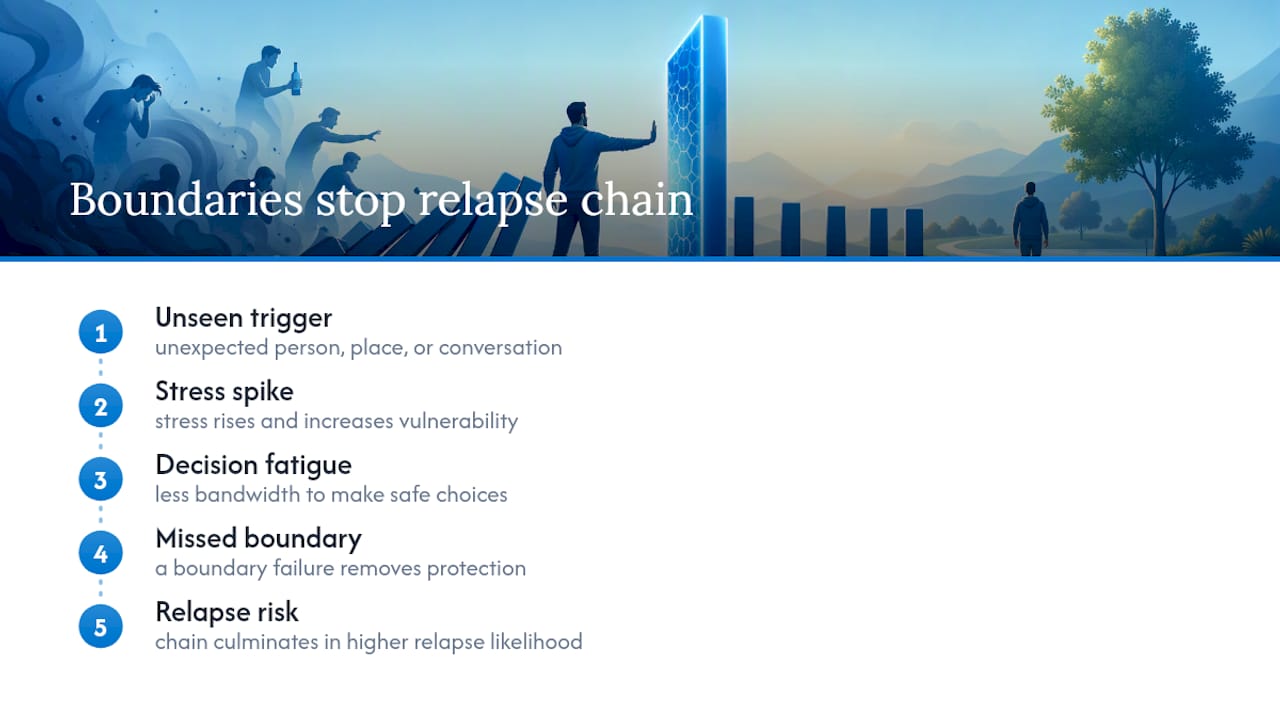
That matters more than it sounds like it should. Boundary failures function as relapse triggers largely because they spike stress and decision fatigue at the exact moments you have the least bandwidth to manage either. A missed boundary at 8 p.m. after a long day is rarely just an isolated slip. It’s often the first domino.
Boundaries also aren’t one-directional. Family members and partners often set their own limits during your recovery, around what they’ll tolerate, what they need to feel safe, or how much contact they can handle right now. Mutual boundary-setting tends to rebuild trust faster than one-sided rules ever do.

What Types of Boundaries Matter Most in Sobriety?
Healthy boundaries in recovery cover more ground than most people expect. Here’s how they break down, with language you can borrow directly.
- Physical: Skip the bar your using friends still frequent. “I’m not coming to happy hour anymore, but let’s grab lunch instead.”
- Emotional: Refuse to absorb someone else’s crisis as your own. “I care about you, but I can’t be your only support right now.”
- Digital: Mute a group chat full of drinking references, or unfollow accounts that glamorize your substance of choice.
- Internal: Run a HALT check (Hungry, Angry, Lonely, Tired) before deciding anything that matters.
- Time and role: Stop being the family member who fixes every crisis. “I love you, and I can’t be the one who handles this tonight.”
Coworkers, partners, and old friends each need a slightly different version of the same sentence: state the limit, skip the apology, offer an alternative when you can.
How Do You Set and Enforce a Boundary?
Setting a boundary is easy to say and hard to do consistently. What works is treating it like a skill you build in stages, not a personality trait you either have or don’t.
- Pick one trigger, one boundary. Don’t try to overhaul every relationship at once. Choose the situation causing the most stress right now, whether that’s a using friend, a critical parent, or a group chat.
- Write the exact sentence. Vague intentions collapse under pressure. “I need space” is weaker than “I’m not answering calls after 9 p.m.”
- Decide the consequence before you need it. Know whether you’ll leave the room, block a number, or end the call, before the moment arrives.
- Rehearse it and loop in support. Say the sentence out loud to a sponsor or therapist first. Staged practice with rehearsal and pre-decided consequences is what separates boundaries that hold from ones that fold at the first pushback. A personal goal framework can help you sequence which boundary to tackle first.
Pro Tip: Track each boundary attempt in a notes app: what happened, what you said, how it landed. Reviewing that log after two or three weeks shows you patterns you’d otherwise miss, like which people test you the most.
How Should You Respond When Someone Violates a Boundary?
The moment someone crosses a line you’ve set is the moment your response actually gets tested. The recommended approach is calm restatement, followed by disengagement if the person keeps pushing. Staying calm keeps things from escalating. Following through, even when it’s uncomfortable, is what makes the boundary mean something the next time.
- Repeat the line once, without new justification.
- Remove yourself physically or end the contact if the person won’t stop.
- If there’s any threat to your safety or sobriety, prioritize leaving over finishing the conversation.
Why Do Boundaries Fall Apart, and How Do You Maintain Them?
Guilt is the most common boundary killer. You’ll hear a version of “you’ve changed” or “I thought you were better now,” and it lands because part of you still wants to fix everyone else’s discomfort. The reframe that actually helps: their disappointment is not evidence that you did something wrong.
- Run HALT before high-stakes conversations. Hunger, anger, loneliness, and fatigue all lower your resistance to backing down.
- Build a short accountability check-in, weekly if possible, with a sponsor or therapist.
- Rehearse the hard sentences again after a slip. One failed boundary doesn’t erase the ones that held.
- Repair without abandoning the limit: “I know that hurt. I still need this boundary in place.”
When Does a Boundary Problem Need Professional Support?
Some boundary struggles are stubborn but manageable on your own. Others are a sign you need more structure than willpower and a good script can provide.
- Repeated relapses tied to the same relationship or environment you can’t seem to limit on your own.
- Safety concerns, including threats, violence, or coercion from someone unwilling to respect any limit.
- A co-occurring mental health condition (anxiety, depression, bipolar disorder) making boundary decisions harder to hold.
- Family conflict that’s escalating rather than settling despite your best efforts.
Support ranges from outpatient therapy and family sessions up through residential care and medication management for more complex cases. Sylmar Treatment Center holds a DHCS license and Joint Commission accreditation, and builds individualized treatment plans for exactly these situations, including co-occurring mental health needs.
What Clinicians Want You to Know About Boundary Guilt
Every client who’s set a real boundary has felt the guilt afterward, and that’s not a sign you did it wrong. Start with one small limit, lean on your support system, and let the discomfort pass instead of undoing the work.
Get Support Setting Boundaries That Actually Hold
Some boundaries you can build with a sponsor, a journal, and a lot of practice. Others need more than willpower, especially when repeated relapse, safety risks, or a co-occurring mental health condition keep undoing your progress. Sylmar Treatment Center’s six-bed residential setting exists for exactly that gap.
The center runs on individualized treatment plans built around comprehensive assessments, not a one-size-fits-all schedule, and covers medically supervised detox, dual diagnosis support for co-occurring disorders, and medication management with psychiatric oversight. It holds a DHCS license and Joint Commission accreditation, and admissions support runs 24/7 for families who need answers immediately, not next week. If boundary violations at home keep putting your sobriety at risk, visit the Sylmar Treatment Center programs page to see which level of care fits, or reach out directly through Sylmartreatmentcenter to start the conversation today.
Frequently Asked Questions
What is the role of boundaries in addiction recovery? Boundaries limit exposure to people, places, and situations that trigger cravings, while creating the predictable routines that make sustained sobriety possible.
How do boundaries prevent relapse? They reduce the stress and decision fatigue that often precede a slip, since boundary failure itself acts as a common relapse trigger.
What if a boundary damages a relationship? A healthy boundary can cause short-term hurt without being wrong. Repair the relationship where you can, but don’t remove the limit just to ease someone else’s discomfort.
When should someone in recovery seek professional help with boundaries? Seek support when boundary struggles trigger repeated relapse, involve safety threats, or overlap with an unmanaged co-occurring mental health condition.
Can family members set boundaries too? Yes. Recovery tends to go better long term when both sides set limits that help everyone feel safer, not just the person in treatment.
This article is general information, not a substitute for advice from a qualified doctor. Consult a qualified healthcare professional about your own circumstances before acting on anything here.
Sources
Mental Health America covers boundary basics in recovery. Psychology Today details violation response steps. QuickMD offers staged boundary-setting guidance. Alcoholics Anonymous provides peer sponsorship resources.
- Screening
- Setting Healthy Boundaries in Addiction Recovery — QuickMD
- Recovery and boundaries — Grata Health
Recommended
- What Recovery Milestones Mean for Your Sobriety | Sylmar Treatment Center
- Why Long-Term Recovery Requires Community Support | Sylmar Treatment Center
- Addiction Recovery Support: A Complete Guide for Families | Sylmar Treatment Center
- Why Detox Environment Affects Outcomes in Recovery | Sylmar Treatment Center