

If your loved one’s addiction or mental health crisis has reached the point where safety, health, or basic functioning is breaking down, staging an intervention is appropriate — and the single most important thing you can do today is call a treatment facility to confirm a bed is available before you hold the meeting.
That sequence matters more than most families realize. An intervention without a ready treatment offer is like a job offer with no start date: the moment passes, doubt creeps back in, and the window closes. Before you gather anyone in a room, run through this quick checklist:
- Pick a small team of trusted participants the person genuinely respects (more on team composition below).
- Secure a verified treatment placement that can accept same-day or next-day admission.
- Choose a sober time and private location — morning is usually best, before the day’s use begins.
- Rehearse individual impact statements so everyone stays on script and calm.
- Set specific, realistic consequences each participant is prepared to follow through on.
- Have a transport plan ready — a bag packed, a car available, a route confirmed.
Safety callout: Do not hold the intervention if your loved one is currently intoxicated, in active withdrawal, or expressing suicidal ideation. If there is immediate danger, call 911 or the 988 Suicide and Crisis Lifeline. Postpone the meeting and address the acute crisis first.
Key Takeaways
Staging a structured, rehearsed intervention with a verified treatment placement ready is the single most effective step a family can take to move a loved one from active addiction into immediate care.
| Point | Details |
|---|---|
| Secure treatment first | Confirm a bed, insurance acceptance, and same-day intake before holding the meeting. |
| Keep the team small | Limit participants to 4–6 trusted people; rehearse every statement before the meeting day. |
| Use “I” statements | Short, factual, first-person impact statements outperform blame or ultimatums every time. |
| Follow through on consequences | Stated boundaries only work if every participant enforces them consistently after refusal. |
| Sylmartreatmentcenter | Offers 24/7 admissions, DHCS licensure, Joint Commission accreditation, and same-day residential intake for families ready to act. |
Table of Contents
- What is an intervention and what does it actually accomplish?
- How do you know it’s time to stage an intervention?
- Who should be on the intervention team?
- When should you hire an intervention professional?
- How to plan an intervention step by step
- How do you find and verify a treatment program to offer?
- What should you actually say? Scripts and language that work
- What happens if your loved one refuses or the meeting goes sideways?
- Common mistakes families make when staging interventions
- What licensed residential treatment actually provides
- What clinicians and families have learned from the intervention process
- Sylmar Treatment Center supports families through same-day admissions
- Sources
What is an intervention and what does it actually accomplish?
A structured intervention is a planned, compassionate meeting in which a small group of trusted people presents a loved one with specific evidence of harm caused by their substance use or mental health crisis, then offers an immediate, concrete path to treatment. Mayo Clinic describes it as a carefully organized process that, when done with professional guidance and a pre-arranged treatment plan, can be a genuine turning point toward recovery.
The goals are specific, not vague:
- Get the person into assessment or treatment the same day — momentum is everything.
- Stop enabling patterns by having each participant commit to clear, stated boundaries.
- Protect the family unit from the financial, legal, and emotional fallout of continued use.
- Start aftercare planning so the conversation about recovery doesn’t end at the door.
What kinds of situations typically lead families here? A DUI that nearly killed someone. A job loss after a third no-call/no-show. An overdose that required emergency room intervention. A mental health episode that ended with police involvement. These are not edge cases — they are the common triggers that push families from hoping things will improve to recognizing that waiting is its own form of harm.
Clinical reviews available through NCBI/PMC consistently show that structured, family-based engagement linked to immediate care produces better initial treatment entry than unstructured confrontations. The difference between a planned intervention and an emotional ultimatum in the kitchen is not just tone — it is outcome.
How do you know it’s time to stage an intervention?
The clearest signal is a pattern, not a single incident. One bad night is not an intervention trigger. A repeating cycle of harm, denial, and failed attempts to stop — that is.
Warning signs that typically justify moving forward:
- Repeated failed quit attempts. Your loved one has tried to stop or cut back multiple times and cannot sustain it.
- Active denial despite visible consequences. They minimize or dismiss job loss, health problems, legal trouble, or relationship damage.
- Escalating health problems. Withdrawal symptoms, blackouts, significant weight loss, or signs of organ stress.
- Legal or financial deterioration. DUIs, arrests, drained savings, unpaid bills, or borrowing money with no repayment.
- Safety concerns for themselves or others. Driving impaired, leaving children unsupervised, or becoming physically aggressive.
- Social withdrawal and isolation. Dropping relationships, hobbies, and responsibilities that once mattered to them.
Timeline guidance: If the danger is immediate — active overdose risk, suicidal statements, or severe withdrawal — do not wait for an intervention. Call 911 or take them to an emergency room. An intervention is a planned process for chronic deterioration, not an acute medical emergency.
For chronic situations, a planning window of A standard planning timeline for chronic deterioration cases is realistic for most families. If the situation is urgent but not a medical emergency, a compressed 24–72 hour timeline is possible with professional help.
When to call 911 or a crisis line instead:
- Expressed suicidal intent with a plan or means
- Active overdose or loss of consciousness
- Severe withdrawal (seizures, confusion, fever)
- Immediate threat of violence to self or others
The 988 Suicide and Crisis Lifeline (call or text 988) and SAMHSA’s National Helpline (1-800-662-4357) are available 24/7 for guidance when you are unsure which path applies.
Who should be on the intervention team?
The ideal team is small, credible, and calm. Partnership to End Addiction recommends limiting participation to 4–6 people the loved one genuinely respects — not the largest group you can assemble, but the most trusted one.
How to build the team, role by role:
- Lead speaker or facilitator. This person opens the meeting, sets the tone, and keeps things on track. If you hire a professional interventionist, they fill this role. If not, choose the family member the person trusts most and who can stay composed under pressure.
- Close family members. Parents, siblings, a spouse or partner — people whose relationships carry real emotional weight. Limit to two or three to avoid the meeting feeling like an ambush.
- A close friend. Someone outside the family who has witnessed the impact firsthand and can speak to it without family-system baggage.
- A faith or community figure (optional). A pastor, sponsor, or mentor the person respects can add moral authority without adding conflict.
- A clinical representative (optional but valuable). A counselor, social worker, or the interventionist themselves can speak to the treatment offer with authority and answer clinical questions on the spot.
Who to leave out: Anyone who cannot stay calm, has enabled the behavior without acknowledging it, or has an unresolved conflict with the person. A volatile participant can derail the entire meeting in under two minutes.
Rehearsal note: Assign a speaking order before the meeting and practice it. Each person should know exactly when they speak, what they will say, and when to stop. Short, rehearsed statements are far more effective than long, emotional ones that drift into argument.
Pro Tip: Have a designated “safe word” the team can use to pause the meeting if things escalate — something neutral like “let’s take a breath” — so everyone knows how to de-escalate without breaking the structure.
When should you hire an intervention professional?
The honest answer: more often than families think. A professional interventionist is not a sign that the family has failed — it is a sign that the family understands the stakes.
AddictionCenter’s step-by-step guide specifically recommends professional facilitation when there is risk of violence, severe mental illness, suicidality, or polysubstance use. Those are not rare circumstances. They describe a significant portion of the families who reach the intervention stage.
What a trained interventionist provides:
- Risk assessment before the meeting, including screening for violence history, psychiatric conditions, and withdrawal risk.
- Facilitation of the meeting itself — keeping the conversation structured, de-escalating tension, and redirecting when participants go off script.
- Rehearsal sessions with the team, including coaching on impact statements and objection handling.
- Safety planning for scenarios where the person becomes hostile or the meeting needs to end early.
- Direct linkage to treatment — many interventionists have established relationships with specific facilities and can coordinate same-day transport.
Cost considerations: Interventionist fees vary widely. A single-day engagement typically runs from a few hundred to several thousand dollars depending on credentials, location, and scope. Some fees may be partially covered under behavioral health benefits — call your insurance plan’s member services line and ask specifically about “intervention services” or “case management” benefits.
Questions to ask before hiring:
- What credentials do you hold (ARISE, CIP, CADC, or similar)?
- How many interventions have you facilitated in the past year?
- What is your safety protocol if the person becomes violent or the meeting needs to stop?
- Do you have relationships with treatment facilities, and can you arrange same-day transport?
- What happens if the person refuses — do you provide follow-up support?
How to plan an intervention step by step
This is where most families underinvest. The meeting itself is 30–60 minutes. The planning behind it is what determines whether those 30–60 minutes change a life.
The core planning sequence:
- Form the team and assign roles (see above).
- Gather facts — document specific incidents, dates, and consequences. Medical records, legal documents, financial statements, and employer communications all strengthen the case.
- Research and secure a treatment placement before anything else. Confirm bed availability, insurance acceptance, and same-day intake capability.
- Arrange transport and logistics — who drives, what the person should bring, whether a bag is pre-packed.
- Handle dependent care — childcare, pet care, and employer notification if the person will be entering residential care.
- Rehearse — run through the full meeting at least once, including objections and refusal scenarios.
- Set the time and place — a private, familiar location, ideally a morning when the person is most likely to be sober.
- Hold the meeting and follow through.
Planning timeline by urgency without specific durations:
| Scenario | A planning window appropriate to the urgency of the situation | Who Leads |
|---|---|---|
| Urgent (acute safety risk, no violence history) | 24–72 hours | Family + admissions coordinator |
| Standard (chronic deterioration, stable safety) | A standard planning timeline for chronic deterioration cases | Family + optional interventionist |
| Extended (complex family dynamics, multiple prior attempts) | An extended planning timeline for complex family dynamics or multiple prior attempts | Professional interventionist |
On the meeting day: Decide in advance who brings what (printed statements, insurance cards, the person’s ID, a packed bag). Arrange seating so the person is not blocked from the exit — they need to feel they can leave, or the meeting reads as coercive. Have the safe word agreed upon. Know the name and direct number of the admissions coordinator at the treatment facility.
Safety plan: If the person arrives intoxicated, end the meeting immediately. Reschedule for a sober time. If they become threatening, leave the room and call 911. No intervention outcome is worth physical harm to any participant.
Mayo Clinic’s guidance on interventions is clear: never hold the meeting while the person is intoxicated or in active withdrawal or psychosis. Pick a sober moment, and always have a de-escalation and emergency plan in place.
How do you find and verify a treatment program to offer?
The most common reason interventions fail is not a bad script or the wrong participants. It is showing up without a verified, ready treatment option. When someone says yes in that room, the window is measured in hours — sometimes less.
Step-by-step process for finding and confirming a placement:
- Start with SAMHSA’s treatment locator at findtreatment.gov to identify licensed facilities in your area that accept urgent referrals.
- Confirm state licensure. Every legitimate residential facility should hold a current license from its state’s Department of Health Care Services (or equivalent). Ask for the license number and verify it on the state’s public database.
- Confirm Joint Commission accreditation or equivalent (CARF is another recognized body). This is not optional — it is the baseline indicator of clinical quality.
- Ask specifically about medical detox capability. If your loved one uses alcohol, benzodiazepines, or opioids, medically supervised detox is a safety requirement, not a preference. Confirm the facility has on-site medical staff. The detox process for families involves more clinical oversight than many families expect.
- Confirm dual-diagnosis support if your loved one has a co-occurring mental health condition. Not all residential programs have psychiatric coverage on staff.
- Ask about bed-hold policy. If the person agrees at the intervention, how long will the facility hold the bed? Same-day admission is ideal; 24-hour holds are common.
- Verify insurance acceptance. Call the facility’s admissions line with your insurance card in hand. Ask whether they are in-network, what the pre-authorization process looks like, and what out-of-pocket costs to expect.
- Arrange transport in advance. Know who is driving, or whether the facility can send a transport coordinator.
Partnership to End Addiction recommends verifying credentials, medical capability, and transportation policies before you ever mention the facility’s name at the intervention. Offering a placement you haven’t confirmed is a credibility risk you cannot afford.
For families comparing inpatient versus outpatient detox options, the clinical rule of thumb is straightforward: if there is any risk of complicated withdrawal, inpatient medical detox is the safer choice.
What should you actually say? Scripts and language that work
The most effective intervention statements are short, specific, and grounded in observable facts. They are not accusations. They are not predictions. They are “I” statements that describe what the speaker witnessed and how it affected them.
Structure for each impact statement:
- Open with love or relationship context (“I love you and I’m here because I’m scared.”)
- State one or two specific incidents with dates or details (“In March, I found you unconscious on the kitchen floor.”)
- Describe the personal impact (“I haven’t slept a full night since. I check my phone every hour.”)
- Close with the ask (“We’ve arranged a place for you to get help. We’re asking you to go today.”)
Sample language by relationship:
Parent: “I’ve watched you disappear over the past two years. The person I raised is still in there, and I’m not willing to give up on them. We have a place ready for you today. Please come with us.”
Partner: “I can’t keep pretending things are okay when they’re not. I love you, and I’m terrified of where this is going. We’ve made arrangements. I’m asking you to take this step with me.”
Friend: “You’ve been my closest friend for fifteen years. I’ve watched this take pieces of you. I’m here today because I’m not ready to lose you. There’s a program ready for you right now.”
What to avoid:
- Blame language (“You’ve ruined everything,” “You always do this”)
- Threats without follow-through (“I’ll leave you if you don’t go” — only say it if you mean it)
- Debating while they are intoxicated or in denial spirals
- Sarcasm, comparisons to other family members, or bringing up unrelated grievances
- Long monologues — keep each statement under 90 seconds
Rehearsal checklist: Time each statement. Run through the full sequence at least once. Practice the most likely objections: “I can stop on my own,” “I’m not that bad,” “I’ll go next week.” Have a calm, brief response ready for each. The goal is not to win an argument — it is to stay calm and return to the offer.
What happens if your loved one refuses or the meeting goes sideways?
Refusal is not failure. It is a data point. Many people who initially refuse an intervention enter treatment within weeks when the family maintains its stated boundaries.
Immediate protocols if things go off script:
- If the person becomes threatening or the room feels unsafe, use the safe word and end the meeting. Do not escalate. Exit calmly and call for help if needed.
- If they arrive intoxicated, do not proceed. Acknowledge them warmly, say the meeting will happen at another time, and follow through.
- If they walk out, do not chase or escalate. Let them go. The boundaries you stated still stand.
Consequences that carry weight (and that you must follow through on):
- No longer providing financial support for living expenses
- Not bailing them out of legal situations
- Not allowing them to stay in the family home while actively using
- Ending or limiting contact until they engage with treatment
These are not punishments. They are the natural result of the family no longer participating in the conditions that enable continued use. State them clearly at the intervention, and follow through — every time you don’t, you lose credibility for the next conversation.
If they say yes: Move immediately. Have the car ready, the bag packed, and the admissions coordinator’s number dialed. The window between “yes” and second thoughts can be very short.
If they say no: Schedule a follow-up conversation within a week. Continue enforcing boundaries. Consider CRAFT (Community Reinforcement and Family Training), a structured, evidence-based approach that teaches families how to reduce enabling and increase the person’s motivation to seek treatment without confrontation. Outpatient engagement offers are also worth keeping on the table.
Emergency escalation: If at any point during or after the intervention the person expresses suicidal intent, shows signs of severe withdrawal (seizures, confusion, fever, rapid heart rate), or becomes violent, call 911 immediately. Do not attempt to manage a medical emergency without professional help.
Common mistakes families make when staging interventions
Most intervention failures are preventable. The same errors show up repeatedly.
- No treatment placement confirmed. The person says yes, and the family has nowhere to send them. The moment dissolves. Always secure the bed first.
- Too many participants. Eight people in a room feels like a tribunal. Stick to 4–6 trusted individuals. More voices do not mean more persuasion — they mean more chaos.
- Ambush-style accusations. Walking in with anger and blame instead of prepared, compassionate statements turns the meeting into a fight. Rehearse. Every participant, every time.
- Holding the intervention while the person is intoxicated. Nothing productive happens. The person cannot process what is being said, and the family’s credibility takes a hit.
- Consequences that aren’t followed through. If you say you will stop paying rent and then pay it anyway, you have taught the person that your boundaries are negotiable. Follow through is not cruelty — it is the only thing that makes the intervention meaningful.
- No professional present when the situation calls for one. Volatile family dynamics, a history of violence, or severe psychiatric symptoms are not situations to navigate without trained support.
- Skipping rehearsal. Unrehearsed participants drift into blame, go too long, or freeze. One run-through changes the entire dynamic.
Pro Tip: Assign a single person to handle the logistics of the treatment offer — the facility name, the admissions contact, the transport plan. That person speaks last and delivers the offer clearly and calmly. Separating the emotional statements from the logistical offer keeps the meeting from collapsing into confusion.
What licensed residential treatment actually provides
Before you offer a residential placement at an intervention, you need to know exactly what you are offering. Families who can describe the program clearly — what happens on day one, who the clinical staff are, what the daily structure looks like — are far more persuasive than those who say “there’s a place that can help.”
What a quality residential program provides:
- Medically supervised detox with 24/7 nursing or physician oversight for safe withdrawal management
- Psychiatric evaluation and dual-diagnosis support for co-occurring conditions like depression, anxiety, PTSD, or bipolar disorder
- Individualized treatment planning based on a comprehensive clinical assessment at intake
- Structured daily programming including individual therapy, group sessions, and psychoeducation
- Family communication protocols so you stay informed and involved during treatment
- Discharge and aftercare planning that begins at intake, not at the end of the program
Provider capabilities to confirm before the intervention:
- Current state license (DHCS in California, or equivalent in your state)
- Joint Commission or CARF accreditation
- On-site medical staff for detox management
- Psychiatric coverage for dual-diagnosis cases
- Bed-hold policy for same-day admissions
- Family intake procedures and communication policies
- Insurance verification and billing support
What to prepare for immediate admission: Bring a government-issued photo ID, insurance card, a list of current medications with dosages, any relevant medical or psychiatric records, and a signed consent form if the facility requires one at intake. Pack enough clothing and personal items for the program’s expected length. Leave valuables at home.
Treatment pathway overview:
| Pathway | Primary Use | Typical Duration |
|---|---|---|
| Inpatient medical detox | Acute withdrawal management, safety monitoring | 3 days |
| Residential rehabilitation | Structured recovery programming post-detox | 90 days |
| Intensive outpatient (IOP) | Step-down or lower-acuity cases | 8 weeks |
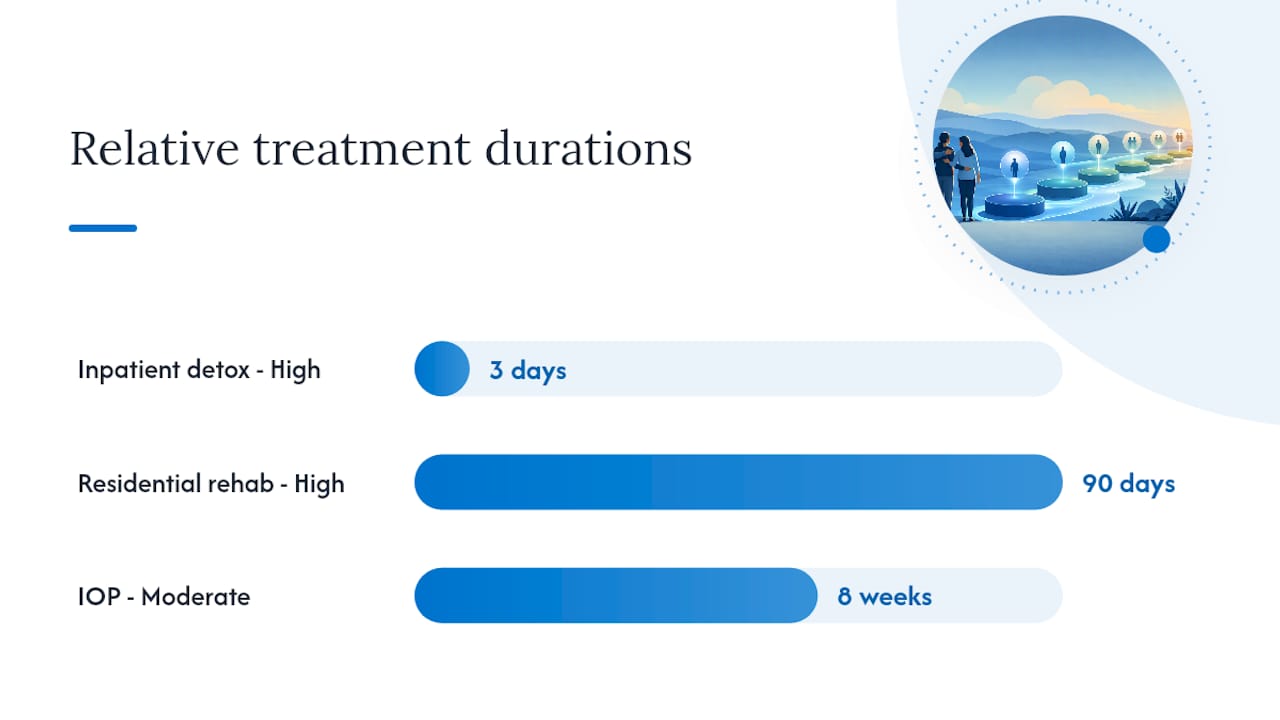
For families trying to match clinical needs to the right level of care, the detox versus rehabilitation distinction is worth understanding before the intervention. Detox addresses the physical dependency; rehabilitation addresses the behavioral and psychological patterns that sustain it. Most people need both.
If your loved one has a co-occurring mental health condition, confirm that the facility offers dual-diagnosis support with integrated psychiatric care — not just a referral to a separate provider after discharge.
What clinicians and families have learned from the intervention process
From a clinical standpoint, the interventions that lead to same-day admission share a few consistent features: the team is small and rehearsed, the treatment offer is specific and immediately available, and at least one person in the room stays completely calm regardless of how the person responds. That calm presence — whether it is a professional interventionist or a steady family member — often determines whether the conversation stays productive or collapses into conflict.
The emotional reality for families is harder to describe. Many families describe the period before an intervention as a kind of suspended grief — knowing something has to change but dreading the confrontation. What tends to help is the structure itself. Having a plan, a script, and a team means the family is not improvising in the most emotionally charged moment of their lives. Following through on stated consequences, even when it is painful, is what preserves the family’s credibility and, ultimately, the relationship. Families who hold their boundaries consistently report that their loved ones eventually re-engage with treatment — sometimes weeks later, sometimes months. The intervention plants a seed even when it doesn’t produce an immediate yes.
Sylmar Treatment Center supports families through same-day admissions
When a loved one says yes at an intervention, the next hour matters more than the next week. Sylmartreatmentcenter offers 24/7 admissions support specifically designed for families in exactly this situation — a verified bed, a clinical team ready at intake, and a process built around same-day placement.
Sylmartreatmentcenter holds a DHCS license and Joint Commission accreditation, so families can present the placement with confidence. The six-bed residential setting means each person receives genuinely individualized care — not a bed in a crowded facility, but a clinical team that knows their name and their history by day two. Programs cover medically supervised detox, residential rehabilitation, dual-diagnosis psychiatric support, and individualized treatment plans built from a comprehensive intake assessment.
To prepare for the call: have your loved one’s insurance card, a list of current medications, and a brief summary of their substance use history ready. Admissions staff can walk you through insurance verification, answer clinical questions, and confirm bed availability in a single call. Explore the full range of residential and detox programs and reach out to the admissions team today.
Sources
These are the primary resources to consult when verifying treatment credentials, finding urgent help, or deepening your understanding of the intervention process.
- Intervention: Help a loved one overcome addiction - Mayo Clinic
- Samhsa
- Ncbi
- Staging an intervention - Partnership to End Addiction
- A Step-by-Step Guide To Staging An Intervention
This article is general information, not a substitute for advice from a qualified doctor. Consult a qualified healthcare professional about your own circumstances before acting on anything here.
Recommended
- Integrated Treatment Plan Creation Guide for Families | Sylmar Treatment Center
- What Is a Treatment Center Intake? A Family Guide | Sylmar Treatment Center
- What Does Detox Involve for Families: A Guide | Sylmar Treatment Center
- What Is a Family Recovery Program? A Guide for Families | Sylmar Treatment Center