

Cocaine withdrawal typically brings an intense psychological crash that peaks within the first week or two, not a medically dangerous physical syndrome like alcohol or benzodiazepine withdrawal. The main risks are suicidal thinking, psychosis, prior seizure history, or heavy polysubstance use, all of which call for supervised evaluation. There is no FDA-approved medication for cocaine withdrawal itself, so the standard of care combines behavioral treatment with symptom-directed medical support.
TL;DR:
- Supervised detox is necessary if there are suicidal thoughts, psychosis, seizure history, heavy polysubstance use, or an unstable living situation.
- Withdrawal symptoms peak within the first week to two, with cravings and fatigue lasting longer, sometimes extending into months during protracted phases.
- Behavioral treatments like contingency management and cognitive behavioral therapy are most effective when started during withdrawal, not after symptoms resolve.
- No FDA-approved medication exists for cocaine withdrawal, but symptom-directed off-label drugs such as topiramate and bupropion may help in specific cases under medical supervision.
- Managing sleep, nutrition, gentle activity, and safety plans at home is viable for mild withdrawal, but severe symptoms or risk factors require immediate supervised care.
Table of Contents
- What Does Cocaine Withdrawal Feel Like?
- How Long Does Cocaine Withdrawal Last?
- When Do You Need Supervised Detox Instead of Home Management?
- Which Behavioral Treatments Actually Reduce Relapse?
- Do Any Medications Help With Cocaine Withdrawal?
- What Can You Do at Home While Arranging Care?
- What Happens Months Later? Managing PAWS and Relapse Risk
- How a Small, Accredited Program Handles Cocaine Withdrawal
- What Actually Matters in Cocaine Withdrawal Care
- Ready for Supervised Detox? Here’s How Sylmar Helps
- Sources
- FAQ
What Does Cocaine Withdrawal Feel Like?
The psychological symptoms hit hardest. Expect intense drug cravings, depression that can feel disproportionate to the situation, anhedonia (a flat inability to feel pleasure), irritability, anxiety, and in some cases paranoia that lingers from the binge itself.
Physically, the body seems to shut down rather than revolt. Common complaints include:
- Deep fatigue and hypersomnolence (sleeping far more than usual)
- Increased appetite, sometimes dramatically
- Slowed thinking and poor concentration
- Vivid, unpleasant dreams during the first week
The NHCHC’s substance use guidelines describe this initial “crash” as generally improving over a period of about one to two weeks. But a shorter crash is not the same as full recovery. Depression, insomnia, and anxiety often persist beyond that window as part of a slower protracted phase.
Some symptoms are not just uncomfortable, they’re urgent. Suicidal ideation, active psychosis, or severe agitation during withdrawal need same-day medical attention, not a wait-and-see approach.
How Long Does Cocaine Withdrawal Last?
Withdrawal unfolds in overlapping phases rather than a single countdown clock.
- Acute crash (hours to days): cravings, exhaustion, and mood crash hit fast, usually within hours of the last use, and remain intense for a period typically lasting around one to two weeks, as noted by NHCHC guidance.
- Early protracted phase (weeks 2 to 4): sleep and appetite start to normalize, but mood swings, low motivation, and cravings triggered by stress or cues can persist.
- Late protracted phase / PAWS (months): intermittent depression, anxiety, and cravings can resurface for months, especially around triggers.
Nobody’s timeline is identical. Heavy, long-term use tends to stretch recovery out further. So does polysubstance use, particularly combining cocaine with alcohol or opioids, and any underlying mental health condition like bipolar disorder or major depression. A person who used heavily for years and also struggles with untreated anxiety is working with a different recovery curve than someone with a shorter, lighter use history.
When Do You Need Supervised Detox Instead of Home Management?
Not everyone needs to be admitted somewhere to get through cocaine withdrawal safely. But certain signs mean home management is the wrong call, and clinical guidance backs specific triage criteria for making that decision.
Seek supervised care if any of these apply:
- Suicidal thoughts, plans, or a recent attempt
- Psychotic symptoms, including paranoia severe enough to distort reality
- A history of seizures during past withdrawal episodes
- Heavy polysubstance use, especially cocaine combined with alcohol or benzodiazepines
- An unstable living situation with no safe place to recover or no one to check in
A review of psychostimulant withdrawal evidence notes that many people can manage the acute crash outside a hospital, but recommends inpatient care specifically for those risk factors. Medical detox offers 24/7 monitoring, short-term medication for acute agitation or insomnia, and a psychiatric evaluation that a home setting simply can’t replicate.
If any red flag applies right now, don’t wait for an appointment. Go to an emergency department for immediate danger, call a crisis line for suicidal thoughts without immediate danger, or contact an addiction program’s intake line for a same-day clinical assessment. Sylmar Treatment Center walks through exactly this decision tree in its guide to inpatient versus outpatient detox.
Pro Tip: If you’re unsure whether symptoms qualify as an emergency, treat any mention of suicide, even a passing comment, as one. Err toward calling, not waiting to see if it passes.
Which Behavioral Treatments Actually Reduce Relapse?
Medication isn’t the main lever here. Behavioral treatment is, and the evidence for it is stronger than most people expect.
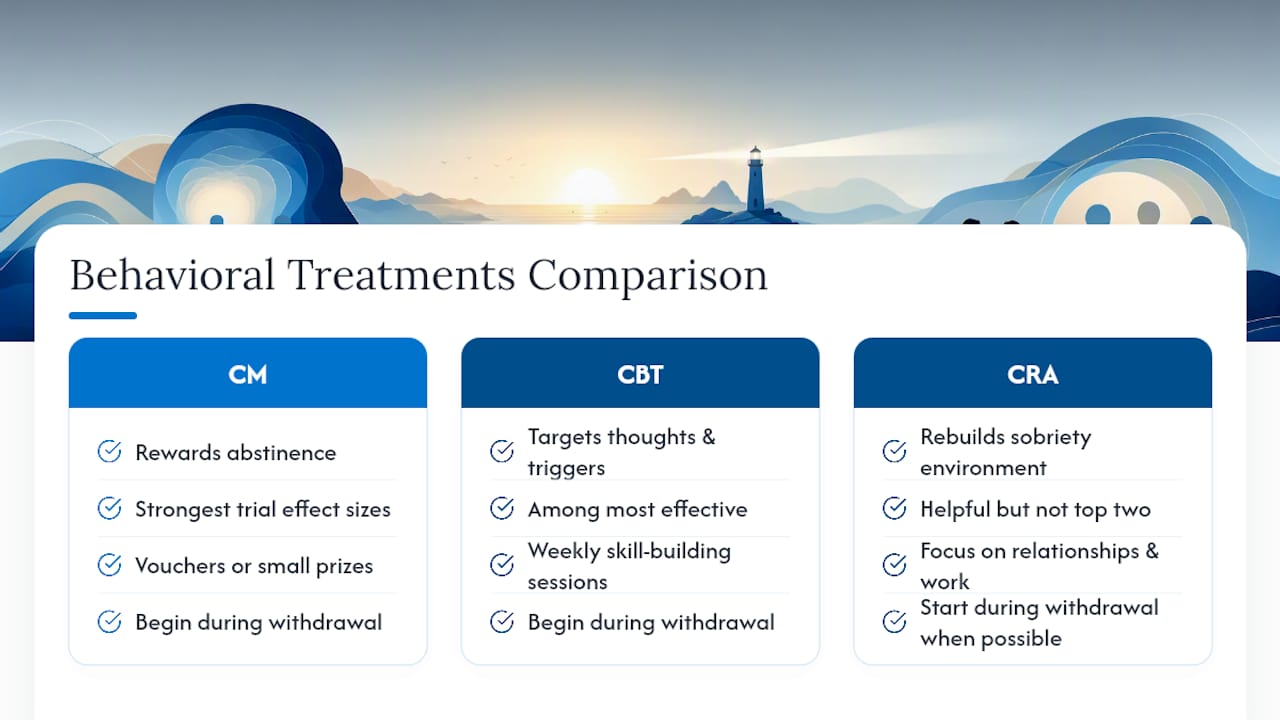
Contingency management (CM) rewards verified abstinence, usually through vouchers or small prizes tied to negative drug tests. It sounds almost too simple to work, but it produces the strongest effect sizes of any behavioral intervention for stimulant use disorder in randomized trials, which is why ASAM/AAAP guidelines list it as a standard approach rather than an alternative one.
Community reinforcement approach (CRA) rebuilds a person’s environment around sobriety instead of drug use, addressing relationships, employment, and recreational activities that don’t involve using.
Cognitive behavioral therapy (CBT) targets the thought patterns and triggers that drive cravings, typically through weekly sessions that build coping skills for high-risk situations.
Motivational interviewing helps ambivalent patients build their own case for change rather than being told what to do.
A review in the International Journal of Neuropsychopharmacology identifies CM and CBT specifically as the most effective, evidence-based options for supporting recovery once acute withdrawal passes. Sylmar’s own breakdown of contingency management for stimulant use disorder covers how these programs structure incentives in practice.
Pro Tip: Behavioral treatment works best when it starts during withdrawal, not after. Waiting until symptoms fully resolve often means losing the motivation window entirely.
Do Any Medications Help With Cocaine Withdrawal?
No medication is FDA-approved specifically for cocaine withdrawal. That single fact surprises a lot of people who assume there’s a straightforward pharmaceutical fix the way there is for opioid withdrawal.
What clinicians actually use is symptom-directed and often off-label. A comprehensive evidence review found inconsistent signals across several candidates:
- Topiramate showed some effect in select trials, but results are mixed
- Bupropion has limited, replicated support
- Modafinil has been studied for fatigue and craving with inconsistent results
- Naltrexone shows conditional signals in certain patient subgroups
- Desipramine produced modest effects in older trials that haven’t held up consistently since
The same review notes that some combinations, like topiramate paired with extended-release mixed amphetamine salts or bupropion, showed promise in select trials, though overall certainty stays low. The ASAM/AAAP clinical practice guideline frames these as conditional recommendations, meaning they may help specific patients but shouldn’t be treated as a default protocol. Any pharmacotherapy used this way needs psychiatric oversight, both to manage side effects and to track whether it’s actually helping. Sylmar’s medication management program exists for exactly that kind of monitored, individualized approach.
What Can You Do at Home While Arranging Care?
If withdrawal is mild and none of the red flags above apply, there’s still work to do while symptoms run their course.
- Protect sleep and eating, even when appetite feels erratic. Regular meals and a consistent sleep window stabilize mood faster than anything else in the first week.
- Move your body gently. A short daily walk counters the lethargy and anhedonia of the crash better than staying in bed all day.
- Build a daily check-in habit with someone you trust. A quick call or text each morning catches deterioration before it becomes a crisis.
- Remove access points. Delete dealer contacts, avoid the places and people tied to using, and hand off anything that makes relapse one step easier.
- Skip the self-medicating. Reaching for alcohol or sedatives to blunt the crash often creates a second withdrawal problem on top of the first.
Pro Tip: Write your safety plan down before symptoms peak, not during. A list of crisis contacts is far more useful at 2 a.m. than a good intention made a week earlier.
If insomnia or agitation becomes severe enough that home strategies aren’t cutting it, that’s the point to ask about short-term, supervised medication rather than pushing through alone.
What Happens Months Later? Managing PAWS and Relapse Risk
The crash ends, but recovery doesn’t stop there. Post-acute withdrawal symptoms, including depression, insomnia, and anxiety, can persist for weeks to months, and ASAM/AAAP guidelines specifically recommend ongoing assessment during this window to catch decompensation before it turns into relapse.
Cravings during this phase tend to come in waves rather than a steady decline, often triggered by stress, specific places, or even certain people. That pattern is normal, not a sign that treatment failed.
- Relapse during early recovery is common, and it doesn’t erase progress made
- Structured behavioral care for 6 to 12 months gives the best shot at durable change
- Treating sleep, mood, and anxiety symptoms directly improves engagement with ongoing treatment and lowers the odds of walking out of care early
A relapse-prevention plan built during this stretch, not after a slip happens, tends to hold up better under pressure. Sylmar’s piece on why detox alone isn’t treatment covers why skipping this phase is the most common reason people cycle back through detox repeatedly.
How a Small, Accredited Program Handles Cocaine Withdrawal
Sylmar Treatment Center runs medical detox, residential treatment, dual diagnosis support, and medication management inside a six-bed facility, which means staff see fewer patients at once and can track subtle changes in mood or risk that get missed in larger settings. The center holds a California DHCS license and Joint Commission accreditation, credentials that verify clinical standards rather than just marketing claims.
When evaluating any program, ask directly: Is a psychiatrist available on-site or on-call? What’s the staff-to-patient ratio overnight? What’s the specific protocol if someone discloses suicidal thoughts? How does insurance or court-directed placement actually get processed?
What Actually Matters in Cocaine Withdrawal Care
Safety comes before comfort. If someone shows suicidal thinking, psychosis, or a seizure history, get them evaluated immediately, full stop, before worrying about tapering symptoms gently.
Behavioral treatment should start during withdrawal, not after it resolves, because the motivation to change is highest right when things feel worst; programs offering behavioral health and substance abuse treatment support this critical transition from detox to ongoing care. And no protocol works generically. Treatment has to account for co-occurring depression or anxiety and include real follow-up, or the crash just repeats itself in a few months.
— Jim
Ready for Supervised Detox? Here’s How Sylmar Helps
Cocaine withdrawal doesn’t always need a hospital bed, but when suicidal thoughts, polysubstance use, or an unstable living situation show up, waiting it out at home is the wrong call. An intimate six-bed setting means every admission receives psychiatric evaluation and a staff that provides personalized attention, rather than a rotating cast of unfamiliar faces.
The program combines medical detox with dual diagnosis support so co-occurring depression or anxiety gets treated alongside withdrawal itself, not addressed as an afterthought weeks later. Admissions run 24/7, and the intake team can walk you through insurance verification or court-directed placement the same day you call. If cocaine withdrawal has hit the point where cravings, mood, or safety concerns feel out of your control, reach out to Sylmar’s admissions team and start the evaluation today.
This article is general information, not a substitute for advice from a qualified doctor. Consult a qualified healthcare professional about your own circumstances before acting on anything here.
Sources
- Substance use guidelines — Cocaine (NHCHC)
- Clinical management of psychostimulant withdrawal: review of the evidence (PMC)
FAQ
What Is Used for Cocaine Withdrawal?
There’s no FDA-approved medication for cocaine withdrawal, so treatment centers on behavioral care like contingency management and CBT, plus symptom-directed support for sleep, mood, or agitation. Some clinicians use off-label medications such as topiramate or bupropion in select cases, but evidence for these remains mixed.
How Long Do Withdrawal Symptoms Last?
The acute crash typically peaks and improves within one to two weeks, but protracted symptoms like low mood, anxiety, and cravings can persist for weeks to months afterward. Heavy long-term use and co-occurring mental health conditions tend to extend that timeline.
What Is Cocaine Washout Syndrome?
This isn’t a clinical diagnosis in standard addiction medicine guidelines. It’s an informal term sometimes used to describe the acute crash phase, the intense fatigue, depression, and hypersomnolence that follow heavy cocaine use as the body clears the drug.
Is There a Withdrawal Scale for Cocaine?
Clinicians assess withdrawal severity through structured evaluation of psychiatric risk (suicidality, psychosis), physical symptoms, and substance use history rather than a single universally standardized numeric scale like those used for alcohol withdrawal. Programs like Sylmar Treatment Center use comprehensive clinical assessments during intake to determine whether a patient needs medical detox or can be managed at a lower level of care.