

If you or someone you love has epilepsy and is dependent on alcohol, benzodiazepines or another substance that causes dangerous withdrawal, detox should happen under medical supervision. Withdrawal can provoke seizures even in people who have never had one, and epilepsy adds risk. At Sylmar Treatment Center, medically supervised detox takes place in a six-bed, DHCS-licensed, Joint Commission-accredited residential setting with 24/7 admissions support.
TL;DR
- Withdrawal seizures are provoked by stopping a substance. They are not caused by epilepsy itself, but they can happen in people with epilepsy and may make it worse.
- Alcohol, benzodiazepine and barbiturate withdrawal can cause potentially life-threatening seizures.
- A past withdrawal seizure is one of the strongest predictors of another, so history matters when choosing a setting.
- Any seizure during the current withdrawal episode calls for inpatient or medically managed care.
- Never stop alcohol or sedatives abruptly on your own, and never stop seizure medication without your neurologist.
Table of Contents
- Why detox is different when you have epilepsy
- Which substances raise seizure risk
- Risk factors that matter most
- What level of care fits
- How seizure medication is handled
- Warning signs that need emergency help
- What supervised care adds
- Our perspective
- Talk to our admissions team
- FAQ
- Sources
Why detox is different when you have epilepsy
Epilepsy is a condition of recurring, unprovoked seizures. A withdrawal seizure is something else: the brain, adapted to a depressant such as alcohol, becomes overexcited when the substance is removed. The Epilepsy Foundation explains that withdrawal seizures are provoked, can occur in people with or without epilepsy, and may differ from a person’s usual seizures or make epilepsy worse.
Research on the brain mechanisms points the same way. A neurobiology review in PMC describes withdrawal seizures as driven by brainstem networks, distinct from genetic or acquired epilepsy. It also notes that repeated detoxifications can raise the likelihood of future withdrawal seizures through kindling, and that up to one third of patients with significant alcohol withdrawal may have seizures. We cover that pattern in our guide to kindling in alcohol withdrawal.
For a person with epilepsy, this means two risks stack up: the provoked seizures of withdrawal, and the lowered seizure threshold that comes with sleep loss, dehydration, electrolyte shifts and anxiety, all common in the first days of detox.
Which substances raise seizure risk
Not every withdrawal carries the same danger. StatPearls states that alcohol, benzodiazepine and barbiturate withdrawal can cause potentially life-threatening seizures. Severe GHB withdrawal can also include seizures, while opioid, caffeine, nicotine and stimulant withdrawal are generally not life-threatening in the same way.
| Substance | Seizure concern | Timing |
|---|---|---|
| Alcohol | Generalized tonic-clonic seizures, possible progression to status epilepticus | Mostly within 6 to 48 hours of the last drink (MedLink Neurology, 2026) |
| Benzodiazepines and barbiturates | Potentially life-threatening seizures | Symptoms may develop 2 to 10 days after stopping (StatPearls) |
| GHB | Seizures and muscle breakdown in severe withdrawal | Varies |
The benzodiazepine window is long, which surprises families. Newer sedative-like drugs behave similarly; see our article on bromazolam withdrawal and seizure risk. For a broader list, read substances requiring medical detox.
Risk factors that matter most
A 2014 meta-analysis found that a prior episode is the most reliable predictor of severe alcohol withdrawal: a prior withdrawal seizure predicted a later one (odds ratio 2.8). Lower platelet counts and lower potassium also predicted seizures and delirium tremens.
A 2016 review reports that more than 90% of acute alcohol-withdrawal seizures emerge within 48 hours, more than half of patients have repeated seizures, up to 5% progress to status epilepticus, and a withdrawal seizure is a strong risk factor for delirium tremens. More than half of withdrawal seizures involve other risk factors, such as prior epilepsy, structural brain lesions or other drug use.
Alcohol withdrawal also lengthens the heart’s QT interval, most between 6 and 48 hours after stopping, which an Epilepsia review links to a higher risk of sudden unexpected death in epilepsy.
In practice, the details to bring to any admission call are:
- Whether you have had seizures, and whether they began before or only during heavy use
- Any previous withdrawal seizures or delirium tremens
- Every medication, including seizure medication, with doses
- Past detox attempts, including ones done at home
- How much and how often you use, and when you last used
What level of care fits
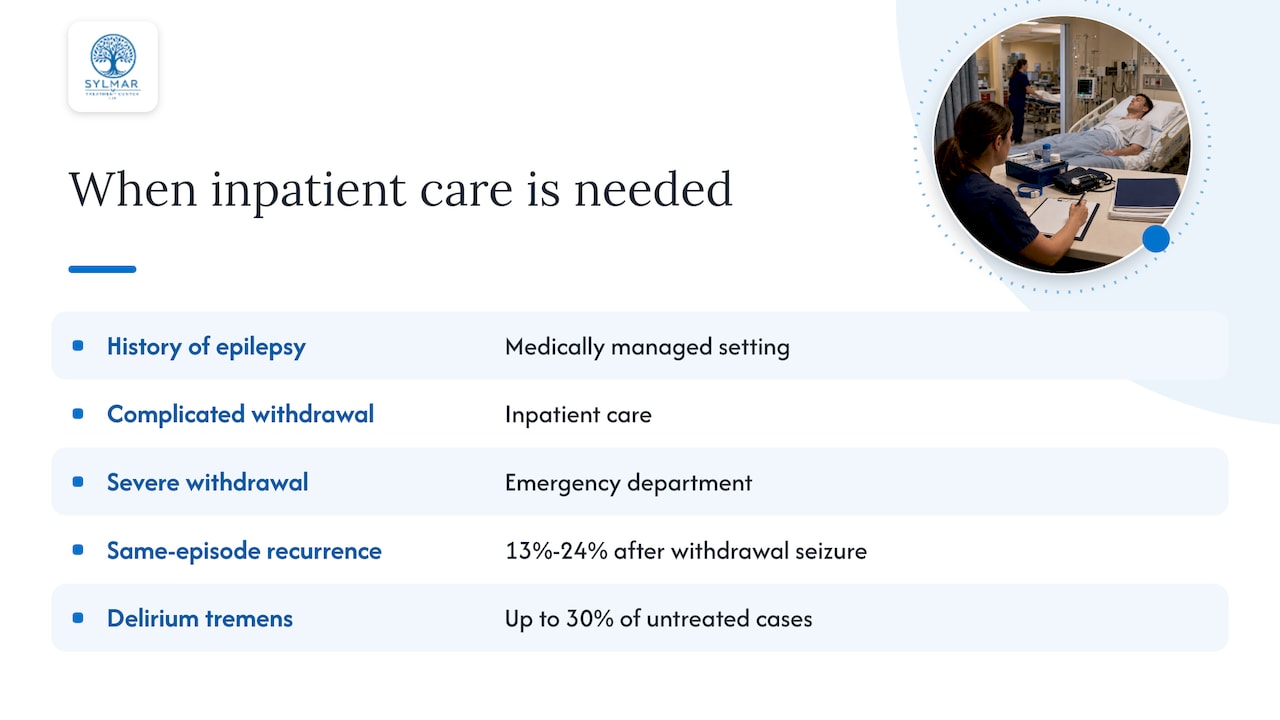
The American Society of Addiction Medicine (ASAM) guideline says a history of epilepsy is appropriate for medically managed settings. Patients with complicated withdrawal, including any seizure during the current episode, delirium signs or new hallucinations, belong in inpatient care, and severe withdrawal warrants an emergency department.
ASAM’s draft guidance on benzodiazepine tapering adds that inpatient care should be considered when a seizure disorder or seizure-threshold-lowering medicines cannot be safely managed outside a hospital-like setting. Tapers with very long-acting agents are typically done in an inpatient or medically managed residential setting.
MedLink Neurology notes that after a withdrawal seizure, recurrence within the same episode is 13% to 24%, and that these patients should be treated as inpatients because delirium tremens can follow in up to 30% of untreated cases.
The decision rests on current signs, the risk of complicated withdrawal and your support at home, not on one label. Home detox rarely meets those conditions. Our family guide to the supervised detox process and the piece on why supervised detox is necessary explain what the days look like.
How seizure medication is handled
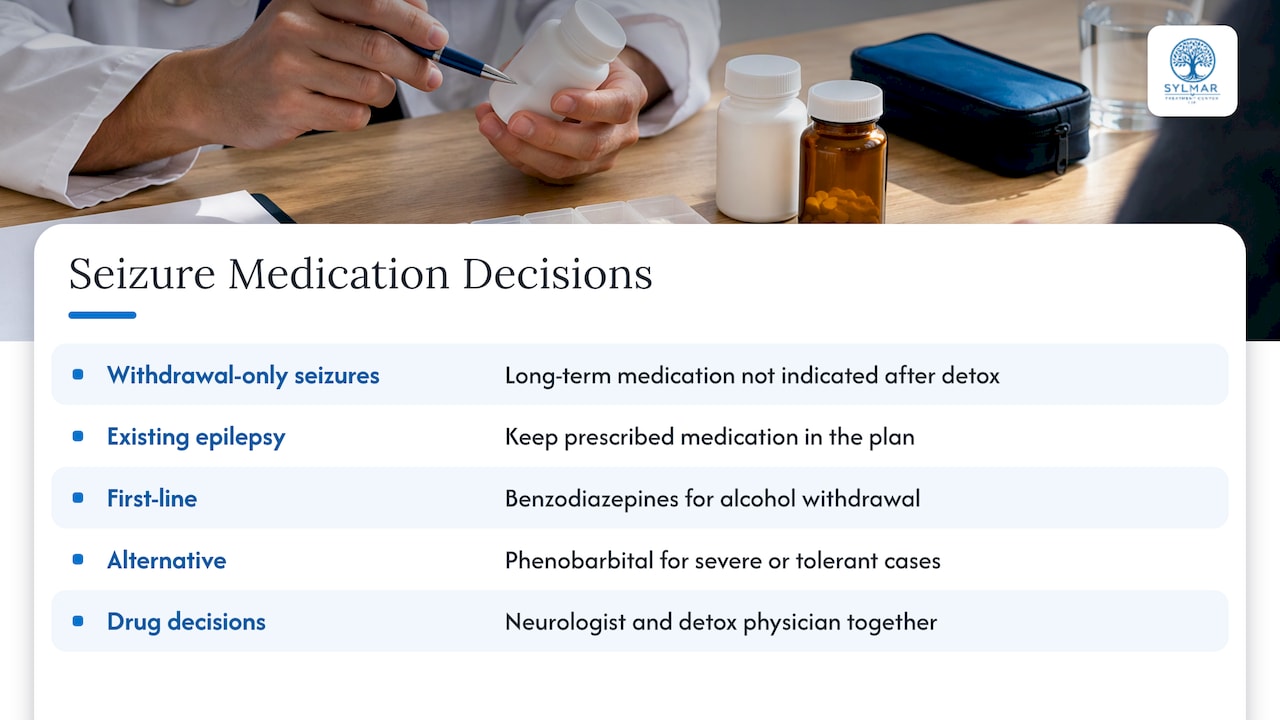
Two things are true at once. Withdrawal seizures can be treated acutely, and the American Epilepsy Society says long-term antiseizure medication is not indicated once detox is complete for seizures that were purely withdrawal-related. But clinicians should identify scenarios with higher epilepsy risk, including prior epilepsy.
If you already have epilepsy, your prescribed medication is part of the plan, not something to drop. The VA Epilepsy Centers of Excellence guide says provoked seizures from alcohol withdrawal are not diagnosed as epilepsy, and short-term treatment can often be discontinued later. Decisions about starting, continuing or stopping any seizure drug belong with your treating neurologist and the detox physician together.
For alcohol withdrawal, an emergency medicine review names benzodiazepines as first-line treatment, with phenobarbital an alternative in severe or benzodiazepine-tolerant cases. It also observes that underdosing is common. That is a reason dosing is best adjusted by clinicians watching you, not by a fixed schedule. More on this in alcohol detox medications.
Warning signs that need emergency help
Call 911 for any of these during withdrawal, at home or in a facility. The California Community Corrections Health Services guide lists them for seizures: lasting longer than 5 minutes after rescue medication, repeated seizures or clusters without recovery of awareness, persistent neurologic deficits, or difficulty breathing afterward.
Intensive-care level concerns in alcohol withdrawal include unstable blood pressure or pulse, respiratory distress, a persistent temperature above 103°F, severe electrolyte abnormalities, or needing frequent high-dose IV sedatives, according to the same Annals of Emergency Medicine review. Discharge from an emergency visit requires minimal symptoms, no history of complicated withdrawal and a caregiver who can watch and return the person if they worsen.
While you wait for help, keep the person on their side, clear the area, do not put anything in their mouth and note the time the seizure started. For free, confidential treatment referral, SAMHSA’s National Helpline runs around the clock at 988-free listings on its site.
What supervised care adds
A seizure in withdrawal is most dangerous when no one is trained to respond and no one knows your history. Watching vital signs, recognizing the timeline and red flags, and preventing complications such as Wernicke encephalopathy are all part of what makes a detox safe. For someone choosing a setting, a guide on selecting a detox setting can help frame the questions to ask.
Our perspective
Families often call us afraid of two things at once: the seizures and the idea of a large, anonymous ward. We built Sylmar around a six-bed setting so the people caring for your loved one know them, their history and their medications.
Epilepsy plus addiction is rarely a single problem. Many clients also live with anxiety, depression or other mental health conditions, so we treat substance use and co-occurring disorders together, with medication management under psychiatric oversight and a care plan built from a comprehensive assessment.
Detox is the doorway, not the destination. From medical detox into residential treatment, the same team can carry the plan forward.
Jim
Talk to our admissions team
Sylmar offers medically supervised detox followed by residential treatment, with dual diagnosis support and medication management. Admissions support is available 24/7, and court-directed placements are available for legal professionals coordinating treatment. Have your seizure history and medication list ready when you call.
To learn about our programs, visit Sylmar Treatment Center.
FAQ
Can someone with epilepsy detox at home?
We advise against it. Alcohol, benzodiazepine and barbiturate withdrawal can cause life-threatening seizures, and epilepsy adds risk. Medically supervised detox lets clinicians monitor you and respond immediately.
Is a withdrawal seizure the same as an epileptic seizure?
No. A withdrawal seizure is provoked by stopping a substance and is not due to epilepsy itself. People with epilepsy can still have both kinds, and withdrawal may make epilepsy worse.
Should I stop my seizure medication during detox?
No, not unless your neurologist and detox physician decide together. Seizure medication is part of your plan, and any change should be made by your clinicians.
How long after the last drink can a seizure happen?
Most alcohol withdrawal seizures appear within 6 to 48 hours, and more than 90% occur within 48 hours. Benzodiazepine withdrawal symptoms may appear 2 to 10 days after stopping.
Sources
- Alcohol as a Seizure Trigger, Epilepsy Foundation
- Update on the Neurobiology of Alcohol Withdrawal Seizures
- Withdrawal Syndromes, StatPearls
- Alcohol withdrawal seizures, MedLink Neurology
- Predictors of severe alcohol withdrawal syndrome
- Alcohol withdrawal syndrome: mechanisms, manifestations
- Alcohol and drugs in epilepsy, Epilepsia
- ASAM alcohol withdrawal management guideline
- ASAM draft benzodiazepine tapering guidance
- American Epilepsy Society, Five Things list
- VA Antiseizure Medication Desk Guide
- Managing Alcohol Withdrawal Syndrome, Annals of Emergency Medicine
- Epilepsy and Seizure Care Guide, CCHCS
- SAMHSA National Helpline