

Withdrawal from more than one substance is not simply two withdrawals added together. Timelines overlap, symptoms mask each other, and medications used for one withdrawal can worsen another. That is why the safest place to stop is a medically supervised setting, where clinicians can reassess you often and adjust treatment as the picture changes. At Sylmar Treatment Center, medical detoxification takes place in a licensed, Joint Commission accredited residential home with just six beds, and admissions support is available 24/7.
This guide explains what makes polysubstance withdrawal risky, which combinations worry clinicians most, which warning signs mean an emergency, and what supervised care looks like, for people who are struggling and for the families and legal professionals who are helping them.
TL;DR
- Polysubstance use means using more than one substance of misuse, at the same time or at different times. Withdrawal can involve several overlapping syndromes with different clocks.
- Alcohol, benzodiazepines and other sedatives can cause seizures and delirium during withdrawal. Opioid withdrawal is rarely fatal by itself, but overdose after stopping is a serious danger.
- Federal guidance says withdrawal from several substances may be best handled in an inpatient setting, because intensity cannot always be predicted.
- Call 911 for seizures, confusion, hallucinations, fever above 100.4°F, or slowed or stopped breathing.
- Detox is the first stage. Lasting recovery usually needs continued treatment for addiction and any co-occurring mental health condition.
Table of Contents
- What polysubstance withdrawal actually is
- Why combined withdrawal is harder to predict
- Which substances carry the most danger
- Combinations clinicians worry about most
- Warning signs that need emergency care
- How supervised detox manages several withdrawals at once
- What comes after detox
- Where Sylmar fits
- Our perspective
- FAQ
- Sources
What polysubstance withdrawal actually is
The Agency for Healthcare Research and Quality (AHRQ) defines polysubstance use as using more than one substance of misuse, whether at the same time, one after another, or at separate times. It is common. A federal guide from SAMHSA, the national agency for behavioral health, reports that more than 90 percent of people entering treatment for opioid use disorder had used at least one non-opioid substance in the past month.
When someone dependent on several substances stops, the body reacts to each one. AHRQ lists the complications clinicians must plan for: intoxication from one substance while another is already in withdrawal, different timeframes for each drug’s symptoms, and withdrawal from one or more substances at once. The Federal Bureau of Prisons’ clinical guidance adds the key point for families: the intensity of withdrawal cannot always be predicted, so frequent clinical assessment and treatment changes are needed.
Why combined withdrawal is harder to predict
Three things make it unpredictable.
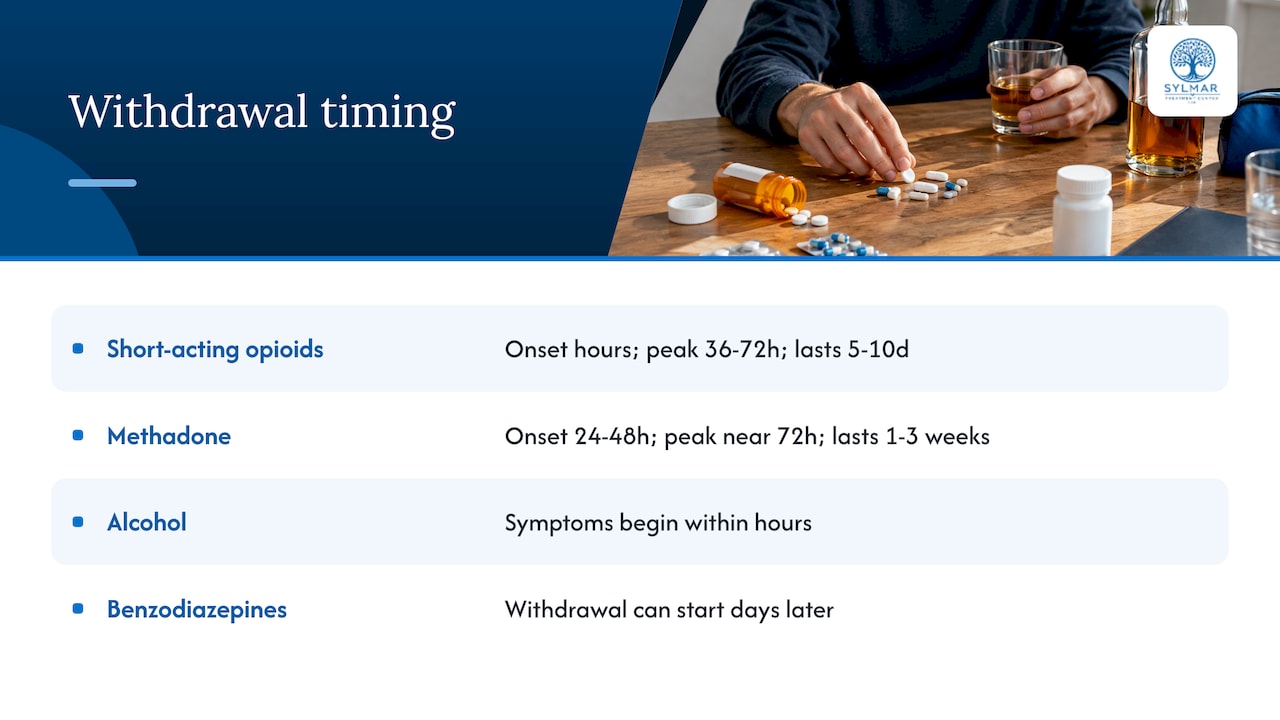
Different clocks. Each substance has its own onset and peak. For short-acting opioids, the Bureau of Prisons guidance says withdrawal begins within hours, peaks at 36 to 72 hours and fades over 5 to 10 days. Methadone withdrawal starts in 24 to 48 hours, peaks near 72 hours and can last one to three weeks. Alcohol symptoms can begin within hours, and benzodiazepine withdrawal can start days after the last dose. So a person can seem to be improving from one syndrome just as another begins.
Masked symptoms. Anxiety, sweating, tremor, nausea and insomnia show up in almost every withdrawal. When several are happening, it is hard to tell which substance is driving which symptom, and which treatment is needed. The ASAM guideline on alcohol withdrawal, from the American Society of Addiction Medicine, tells clinicians not to rule out simultaneous withdrawal from other substances even when alcohol withdrawal is obvious.
Interacting medications. SAMHSA notes that people with concurrent substance use are prescribed more antidepressants, antipsychotics and opioids than the general population, which raises the risk of adverse drug interactions. Anyone treating the withdrawal needs a complete picture of what the person has taken, including prescriptions.
Which substances carry the most danger
Not every substance carries the same physical risk when you stop. The Bureau of Prisons guidance states that alcohol, sedative-hypnotics and anxiolytics produce dangerous and potentially life-threatening withdrawal syndromes. Opioid withdrawal rarely causes death directly, but death can follow indirectly through suicidality or overdose. Stimulant, cocaine, hallucinogen and inhalant withdrawal can generally be managed with psychological support and symptom treatment.
| Substance | What to expect | Main risk |
|---|---|---|
| Alcohol | Symptoms can start in hours; seizures and delirium tremens can follow | Delirium tremens carries a 1% to 5% mortality risk |
| Benzodiazepines and barbiturates | Symptoms develop 2 to 10 days after stopping and can last weeks | Seizures, delirium; potentially life-threatening |
| Opioids (including fentanyl) | Flu-like symptoms, severe restlessness, cravings, peak around 72 hours | Overdose if use resumes; breathing problems when mixed with sedatives |
| Stimulants (methamphetamine, cocaine) | A “crash” of fatigue, low mood and sleep disruption | Severe depression, paranoia and relapse risk; mood symptoms can last weeks to months |
The ASAM/AAAP stimulant guideline notes that abrupt stimulant discontinuation can cause 12 to 24 hours of somnolence and irritability, with depression, anxiety, insomnia and paranoia that may continue for weeks to months. SAMHSA’s TIP 42 describes protracted withdrawal: mood instability, fatigue and insomnia after alcohol, and anxiety or depression after sedatives that some people report for a year or more.
For a closer look at individual drugs, see our guide to substances requiring medical detox.
Combinations clinicians worry about most
Alcohol plus benzodiazepines. Both act on the same calming system in the brain. Stopping both together raises the chance of complicated withdrawal. The ASAM guideline lists concomitant use of other addictive substances and physiological dependence on benzodiazepines or barbiturates as factors that increase the risk of complicated alcohol withdrawal. It also says people physiologically dependent on benzodiazepines should not be treated in an ambulatory setting, and that complicated withdrawal with seizure or delirium signs should be managed as an inpatient. The ASAM committee noted that managing alcohol withdrawal alongside another sedative-hypnotic is more complicated than alongside a stimulant.
Opioids plus benzodiazepines or alcohol. The Department of Justice’s jail withdrawal guidelines say that for combined opioid and benzodiazepine withdrawal, clinicians should stabilize the patient on buprenorphine or methadone and a benzodiazepine before tapering the benzodiazepine. They also warn that benzodiazepines increase the risk of respiratory depression, slowed and shallow breathing, in people taking opioids. Because medications for opioid use disorder can matter for drug screens, families and legal teams often ask about testing; this explanation of how buprenorphine appears on drug tests is a helpful starting point.
Fentanyl with other drugs. SAMHSA names opioids, especially fentanyl or heroin, combined with methamphetamine, benzodiazepines or cocaine, and alcohol combined with benzodiazepines or opioids, as overdose combinations of particular concern. When AHRQ reported that drug overdose deaths passed 70,000 in 2019, nearly half involved multiple drugs. Our overview of opioid withdrawal medications and the clinical guide on precipitated withdrawal after fentanyl explain why the timing of medication matters.
Stimulants plus depressants. Per the CDC as cited by AHRQ, stimulants with depressants, such as amphetamines with alcohol, can cause cardiovascular problems, dehydration, overheating and kidney failure. The same source says mixing drugs is never safe, because the combined effect can be stronger and less predictable than either drug alone.
Warning signs that need emergency care
Some withdrawal symptoms are an emergency. Call 911 or go to the nearest emergency room if you see any of these in yourself or someone else:
- A seizure
- Confusion, a change in mental status, or hallucinations
- Shaking, a racing heartbeat and sweating together with disorientation, which can signal delirium tremens
- Temperature above 100.4°F
- Severe abdominal pain or gastrointestinal bleeding
- Rapidly increasing anxiety or agitation
- Changes in pupil responsiveness
- Slow, shallow or stopped breathing, blue lips or fingernails, clammy skin, or being unable to wake the person
The first group comes from the Bureau of Prisons list of symptoms requiring immediate medical attention. The breathing signs are the opioid overdose symptoms described by the U.S. Department of Veterans Affairs, which also states that people can die from alcohol withdrawal and delirium tremens, from heart attack or seizures, when it is not treated promptly. Opioid overdose is also why naloxone should be on hand: SAMHSA recommends training staff, clients and families to use it and keeping it available.
How supervised detox manages several withdrawals at once
Good polysubstance detox is built on assessment, then constant reassessment.
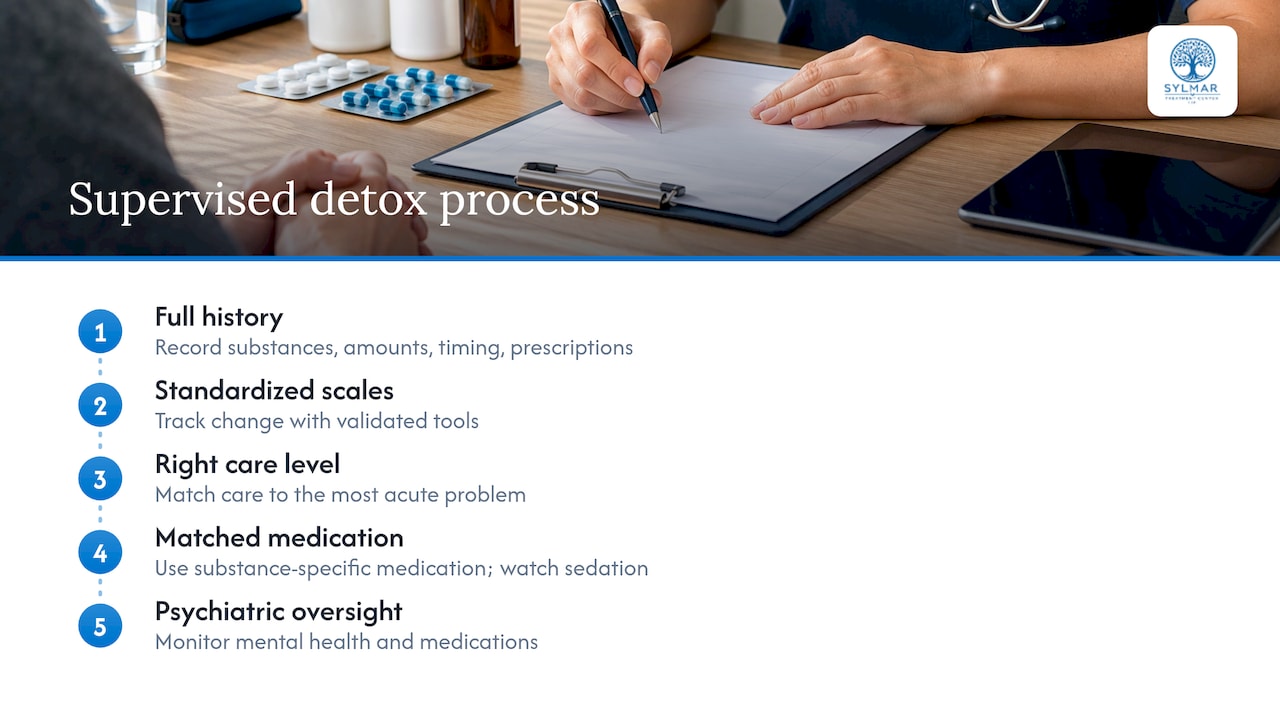
1. A full history up front. Clinicians need to know every substance, the amounts, how recently each was used and any prescriptions. The Department of Justice guidelines say everyone should be screened for withdrawal risk, and that symptoms typically emerge within 72 hours of arrival. At Sylmar, admissions support is available 24/7, and care begins with comprehensive assessments that feed a custom care plan.
2. Standardized scales. SAMHSA recommends assessing withdrawal with validated tools, such as CIWA-Ar for alcohol and the Clinical Opiate Withdrawal Scale for opioids. Scores let the team see whether a person is getting better or worse between checks, which matters when symptoms overlap.
3. The right level of care. The ASAM guideline says patients belong in the level of care that matches their most acute problem. The Department of Justice guidelines name moderate to severe withdrawal from multiple substances, a history of severe or complicated withdrawal, and unstable vital signs that do not respond to medication as reasons to move to a higher level of care. AHRQ states that withdrawal from multiple substances is challenging in outpatient settings and may be best accomplished in an inpatient setting.
4. Medication matched to each substance. AHRQ recommends first-line medications for each substance use disorder, for example buprenorphine, methadone or extended-release naltrexone for opioids, and naltrexone, acamprosate or disulfiram for alcohol. Clinical presentations in an Oregon emergency department fast-facts sheet show why timing is individual: alcohol withdrawal signs can begin 2 to 3 hours after the last drink, while benzodiazepine signs may take 24 to 72 hours. A 2026 clinical presentation on polysubstance withdrawal notes that opioid and alcohol withdrawal can be managed together with close monitoring of combined medication effects, with sedation watched closely. Our pages on alcohol detox medications and detox protocol examples go deeper.
5. Psychiatric oversight. Withdrawal brings depression, anxiety and sometimes paranoia, and these symptoms can persist after the physical ones fade. Sylmar’s medication management includes psychiatric oversight, so mental health symptoms and medications are watched alongside withdrawal.
What a family sees in a supervised setting is covered in our family guide to the detox process and in the article on why supervised detox is necessary.
What comes after detox
Withdrawal management clears the substances from the body. It is the start of treatment, not the whole of it. SAMHSA’s State Opioid Response grant notice says medically managed withdrawal should be paired with ongoing treatment such as the offer of extended-release naltrexone, because the risk of overdose is high if opioid use resumes after tolerance has dropped.
SAMHSA’s guide recommends coordinated care that combines social, behavioral health and medical services in one setting, with evidence-based approaches such as FDA-approved medication with counseling and contingency management. For people who also live with depression, anxiety, trauma or another mental health condition, that coordination is central. Sylmar treats addiction and co-occurring mental health disorders at the same time through its dual diagnosis support, then continues care through residential treatment, behavioral rehabilitation and individualized treatment programs.
For attorneys, probation officers and families coordinating a court requirement, the same continuity matters: a placement that covers detox and the treatment that follows keeps the plan in one place. Sylmar offers court-directed placements for legal requirements.
Where Sylmar fits
If you or someone you love is using more than one substance, the question is not whether you can tough it out. It is where the first days of stopping should happen. Sylmar Treatment Center is a DHCS-licensed, Joint Commission accredited facility with six beds, so each client is known by the staff caring for them. Our programs run from medically supervised detox through residential treatment, with psychiatric medication oversight and individualized plans. Admissions is open 24/7 through our home page, and the medical detox program page describes what care starts with.
Our perspective
Polysubstance withdrawal is the situation where a checklist is not enough. The substances involved, the order they were taken in and the person’s mental health all change what happens next, and the clinical guidance says plainly that intensity cannot always be predicted.
That is why we built Sylmar around six beds. With a small number of clients, the people assessing you are the same people who see you at 3 a.m., and changes get noticed. We pair detox with dual diagnosis care and psychiatric medication oversight because the anxiety, depression and cravings that surface in withdrawal are part of the same story, not a separate one.
Our advice to families is simple: do not wait for a perfect moment, and do not try to manage a multi-substance withdrawal at home. Call, tell us everything that was used, and let us help you decide on the right level of care.
Jim
FAQ
Is polysubstance withdrawal more dangerous than withdrawal from one drug?
It can be. Overlapping syndromes make symptoms harder to read and intensity harder to predict, and the risk rises when alcohol or sedatives are involved. AHRQ also reports higher rates of overdose and more severe medical and psychiatric conditions in polysubstance use than in single-substance use disorders.
How long does polysubstance withdrawal last?
It depends on the substances. Short-acting opioid symptoms typically fade over 5 to 10 days, benzodiazepine symptoms can last weeks, and mood and sleep problems after stimulants or sedatives can continue for weeks to months. A clinician can give a realistic timeline only after assessing what was used and how recently.
Can I detox from several substances at home?
Federal guidance advises against assuming so. AHRQ says withdrawal from multiple substances is difficult outside inpatient care, and ASAM says people dependent on benzodiazepines should not be treated in an ambulatory setting. If you have seizures, confusion or hallucinations, call 911.
What should I tell the admissions team?
Everything: every substance, how much, how often, when you last used, any prescriptions, any past seizures or complicated withdrawals, and any mental health diagnoses. The more complete the list, the safer the plan.
Sources
- Polysubstance Use & Integrated Behavioral Health, AHRQ
- Treating Concurrent Substance Use Among Adults, SAMHSA (2021)
- Medically Supervised Withdrawal, Federal Bureau of Prisons (February 2020)
- ASAM/AAAP Clinical Practice Guideline on Stimulant Use Disorder (2024)
- TIP 42, Substance-Induced Mental Disorder exhibit, SAMHSA (2020)
- Withdrawal Syndromes, StatPearls (2024)
- Alcohol and Drug Education Resources, U.S. Department of Veterans Affairs
- ASAM Clinical Practice Guideline on Alcohol Withdrawal Management (2020)
- Guidelines for Managing Substance Withdrawal in Jails, Bureau of Justice Assistance (June 2023)
- State Opioid Response Grants, SAMHSA (FY 2024)
- Multiple substance (polysubstance) intoxication and withdrawal management, December 2025
- Polysubstance Withdrawal Management, October 2026 presentation